Notebook jobs
A job runs a notebook to completion without a browser — on a cron schedule, or on demand from the UI, API, or CLI — and keeps a durable run history with the rendered outputs. marimo's deterministic DAG execution makes a notebook a good batch unit: a run executes marimo export html against saved notebook source and stores the result beside the run record. Editing, apps, and version history are untouched: a run never writes anything back to the notebook.
Enabling jobs
Jobs are off by default. Set MARIMOHUB_JOBS=on to enable the job API and UI, the Node maintenance scheduler or Cloudflare scheduled() handler, and the job.* project alert kinds. While off, the jobs routes answer 404, GET /api/v1/capabilities reports jobs.available: false, the UI hides its entry points, and stored job definitions and run history are left untouched so the feature can be turned back on without loss.
Create a schedule
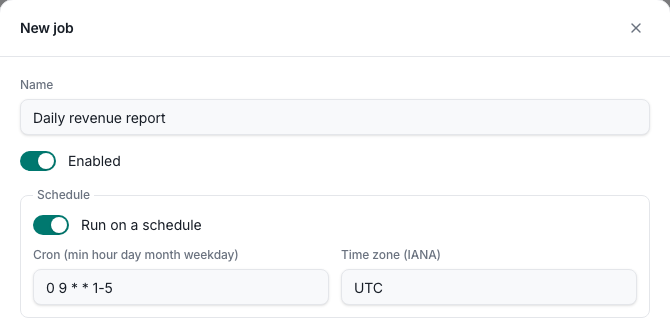
- Open Jobs & schedules from the notebook’s actions menu.
- Select New job and enter a name.
- Enable Run on a schedule, then enter a cron expression and time zone.
- Select Create job.
How it works
- A job belongs to a notebook. Open Jobs & schedules from the notebook's actions menu. On the notebook page, it is in the notebook menu. Click the notebook title to open that menu. Define jobs there: a name, an optional cron schedule with an IANA time zone, parameters, a timeout, a retry policy, and what to do when the previous run is still active. A job without a schedule is manual-only.
- Runs pin notebook source, not every local workspace file. Each run uses a fresh copy-only sandbox (never a bucket mount) and records the notebook version it started from. Git-synced notebooks copy the complete immutable workspace of that version. Local notebooks copy the current workspace, then overlay the pinned version's entrypoint (
notebook.pyunless imported with a different entry file) andpyproject.toml; other local workspace files therefore reflect their values when execution starts. The rendered HTML and captured stdout/stderr live under the run only. They are not notebook versions and never advance the notebook's head. - Parameters reach the notebook as
mo.cli_args(). Eachkey=valuebecomes--key valueafter--on the export command, somo.cli_args().get("region")reads it. Values are strings and are never shell-interpolated. A manual run can override the job's stored parameters for that run only. Parameters are visible to project members who can read the job and run history, so they must not contain secrets. - Node dispatches from the maintenance replica. The replica running
MARIMOHUB_RUN_MAINTENANCE=trueevaluates schedules everyMARIMOHUB_JOBS_TICK_SECONDS, dispatches queued runs under the concurrency caps, enforces run deadlines, and prunes old runs. Without that replica, a Node deployment accepts jobs but leaves manual triggers queued. The Cloudflare reference deployment instead dispatches from its platformscheduled()handler. See Operations. - Exactly once, never backfilled. Every scheduled fire claims an occurrence record keyed by its UTC minute, so two replicas evaluating the same schedule cannot both fire it. After an outage only the latest missed occurrence within
MARIMOHUB_JOBS_CATCHUP_WINDOW_SECONDSruns; a three-day gap produces one catch-up run, not thousands. - Concurrency.
MARIMOHUB_JOBS_MAX_CONCURRENT_RUNSbounds runs holding a sandbox across the deployment andMARIMOHUB_JOBS_MAX_CONCURRENT_RUNS_PER_PROJECTbounds each project's share; further runs wait in the queue, oldest first. Per job, the default policy skips a scheduled fire while the previous run is still active (the skip is recorded in the history); choose "run anyway" to let runs overlap. If active run records cannot be read, the scheduler pauses new scheduled fires and dispatches to preserve these limits. It still enforces deadlines and completes finalization for readable runs. - Timeouts and retries. A run past its timeout (
timeout_seconds, defaultMARIMOHUB_JOBS_DEFAULT_TIMEOUT_SECONDS, capped byMARIMOHUB_JOBS_MAX_TIMEOUT_SECONDS) has its sandbox destroyed and landstimed_out. A failed or timed-out run is retried up tomax_retriestimes afterbackoff_seconds; each attempt is its own run linked to the previous one. - Retention. Run records and outputs older than
MARIMOHUB_JOBS_RUN_RETENTION_DAYSare pruned by the Node maintenance cycle; the Cloudflare scheduled handler prunes with its fixed 30-day retention. Deleting a job removes its history immediately; soft-deleting a notebook or project cancels its active runs, and the hard-delete sweep reclaims the rest. - Compute image and profile. A run provisions exactly as a session start would: the notebook's base image choice (falling back to the deployment default when that image is no longer offered) and its compute profile when the deployment lets editors override (
MARIMOHUB_COMPUTE_PROFILE_OVERRIDE=editors), else the default profile. The appliedimage,compute_profile, andcompute_resourcesare recorded on the run for provenance, like on a session. - Audit events.
job.create,job.update, andjob.deleteland in the project audit log with the actor;job.run.triggerandjob.run.cancelrecord who started or stopped a run;job.run.finishrecords every outcome (status, attempt, exit code, sanitized error code, duration), attributed to the manual triggerer or tosystemfor scheduled runs.
Run states
| Status | Meaning |
|---|---|
queued | Waiting for the scheduler to dispatch it (or for a retry's backoff to elapse). |
provisioning | A sandbox is being created and loaded. |
running | marimo export html is executing. |
succeeded | Every cell ran; the rendered output is available. |
failed | A cell raised, the export could not run, or the sandbox could not be prepared. |
timed_out | The run exceeded its timeout and was reclaimed. |
cancelled | Cancelled by an editor; its sandbox was destroyed. |
skipped | A scheduled fire declined because the previous run was still active (forbid policy). |
When a cell raises, marimo still writes the rendered HTML, so a failed run usually has output showing where it stopped. The run's error carries a sanitized code (NOTEBOOK_FAILED, RUN_TIMED_OUT, …) — never provider messages or secrets. Editors can read the captured logs.
Who can do what
| Action | viewer | editor | manager | admin |
|---|---|---|---|---|
| See jobs and run history | x | x | x | x |
| Open a run's rendered output | x | x | x | x |
| Create, edit, enable, or delete jobs | x | x | x | |
| Run a job now or cancel a run | x | x | x | |
| Read a run's stdout/stderr logs | x | x | x |
Triggering a job starts a kernel, so it takes the same editor gate as starting a session. Run history and outputs follow the static-snapshot posture (viewers can see rendered documents); logs are editor-only because stdout can echo environment values and tracebacks.
Security note. A run executes the notebook's code with the project's resolved integration secrets and federated credentials injected — exactly what an app session carries — regardless of who triggers it or when the schedule fires. The credentials are attributed to the manual triggerer, or to the job's author for scheduled runs. Treat a job definition as you would a shared app.
Notifications
With project alerts enabled, a job can send job.run.failed (once retries are exhausted) and job.run.succeeded events to the project's alert destinations that subscribe to them. The payload names the job, run, status, attempt, and sanitized error code.
MCP
With MCP enabled and MARIMOHUB_JOBS=on, agents can list, create, schedule, and run jobs. Run tools support polling or bounded waits with optional SSE progress notifications. See MCP jobs for inputs and examples.
API
All routes are under /api/v1/projects/{pid}/notebooks/{nid}/jobs and use the standard envelope. Job creation and manual run triggers accept an Idempotency-Key.
| Method | Path | Notes |
|---|---|---|
GET | / | List jobs, oldest first, with cursor pagination. |
POST | / | Create; validates cron/time zone/timeout. |
GET | /{jid} | Read (ETag = updated_at). |
PATCH | /{jid} | Partial update; null clears an optional field. |
DELETE | /{jid} | Requires If-Match; cancels active runs, then deletes. |
POST | /{jid}/runs | Run now; body { "parameters": {…} } overrides per run. |
GET | /{jid}/runs | Run history, newest first, paginated. |
GET | /{jid}/runs/{rid} | One run. |
POST | /{jid}/runs/{rid}/cancel | Cancel (runs are history; never deleted individually). |
GET | /{jid}/runs/{rid}/html | Rendered output, raw text/html. |
GET | /{jid}/runs/{rid}/logs | Captured logs, raw text/plain, editor-only. |
The CLI exposes the same operations under jobs ….
Configuration
| Variable | Default | Meaning |
|---|---|---|
MARIMOHUB_JOBS | off | Turns the feature on (on) or off (off). |
MARIMOHUB_JOBS_TICK_SECONDS | 60 | Node only: scheduler interval on the maintenance replica. |
MARIMOHUB_JOBS_MAX_CONCURRENT_RUNS | 5 | Node only: deployment-wide cap on runs holding a sandbox. |
MARIMOHUB_JOBS_MAX_CONCURRENT_RUNS_PER_PROJECT | 2 | Node only: per-project share of the cap. |
MARIMOHUB_JOBS_MAX_PER_NOTEBOOK | 5 | Node only: job definitions per notebook (0 = unlimited). |
MARIMOHUB_JOBS_DEFAULT_TIMEOUT_SECONDS | 1800 | Node only: run deadline when the job sets none. |
MARIMOHUB_JOBS_MAX_TIMEOUT_SECONDS | 14400 | Node only: ceiling on a job's timeout_seconds. |
MARIMOHUB_JOBS_RUN_RETENTION_DAYS | 30 | Node only: how long run records and outputs are kept. |
MARIMOHUB_JOBS_CATCHUP_WINDOW_SECONDS | 600 | Node only: how stale a missed occurrence may be and still fire, once. |
On Node, the tuning variables apply only while MARIMOHUB_JOBS=on. Jobs grant editors nothing an edit session does not; unattended cost is bounded by the caps and timeouts, and a deployment can turn the feature off at any time.
Cloudflare Workers
The Workers reference deployment reads the same MARIMOHUB_JOBS toggle from its wrangler vars and ticks the scheduler from its five-minute cron trigger, so schedules finer than five minutes are Node-only, and a run is bounded by the Workers invocation limits. It ignores the tuning variables in the table and uses their listed defaults, except that tick cadence comes from the five-minute platform trigger.
See Configuration for the full reference.